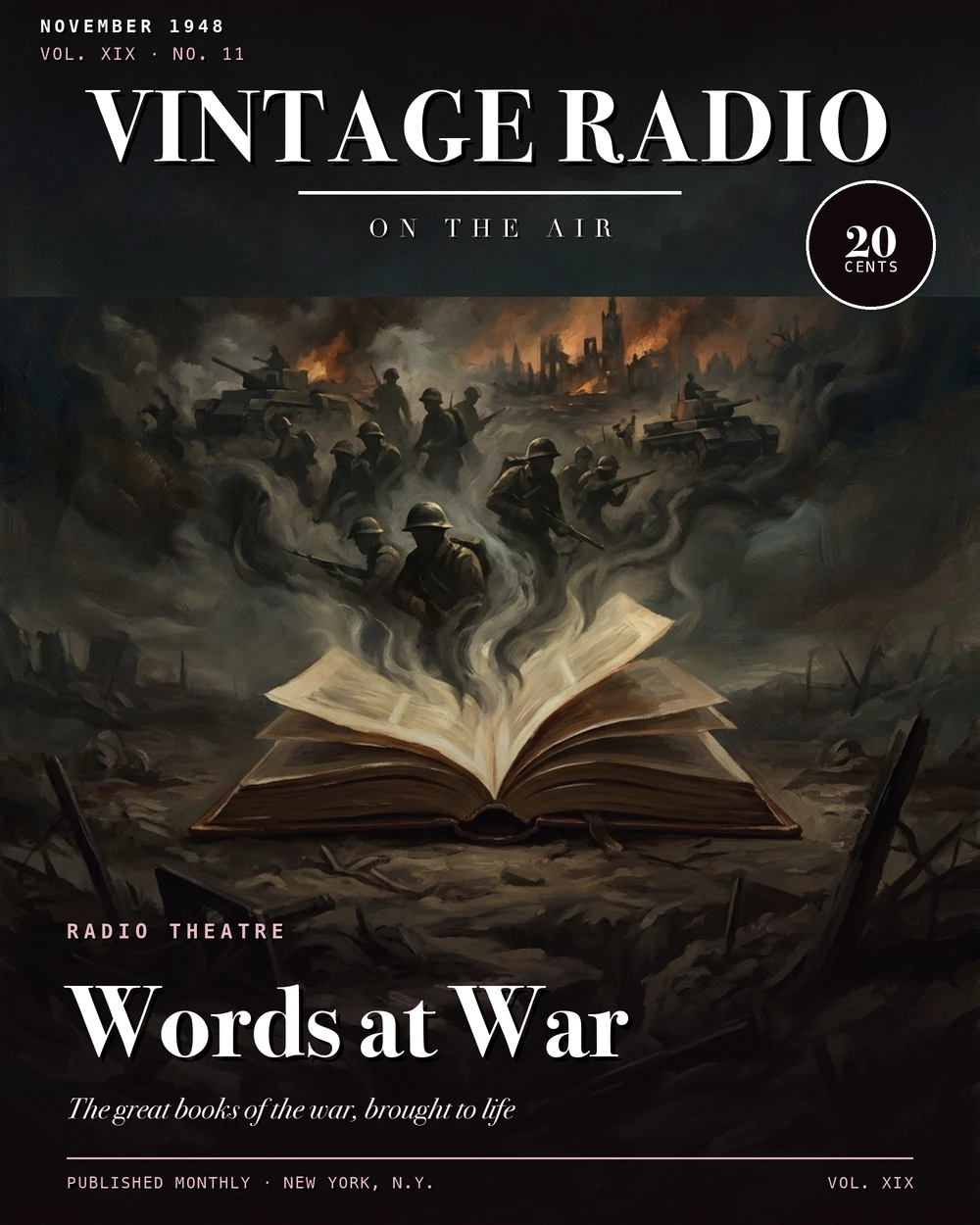
Words at War
How It Came to Be
Words at War arrived on NBC in the summer of 1943 with an unusual institutional pedigree behind it. The U.S. Office of War Information, working alongside the Council on Books in Wartime and NBC, was the organizing force that brought the program to air on June 24, 1943. The Council on Books in Wartime was a non-profit founded in the spring of 1942 by booksellers, publishers, librarians, and authors — its motto was "books as weapons in the war of ideas" — and its stated aims included promoting books to build the will to win, expose the nature of the enemy, disseminate technical information, and clarify war aims and problems of peace. It cooperated with the OWI but was itself a voluntary, non-governmental organization, which gave the show an air of civic seriousness rather than straight government propaganda.
The show debuted as the sustaining summer replacement for Maxwell House Coffee Time, starring Frank Morgan and Fanny Brice, on Thursday nights at 8:00 p.m. OTR researcher Jim Ramsburg has argued that Words at War was arguably born as a reaction to William Robson's actuality-based The Man Behind the Gun, which had debuted on CBS on October 7, 1942, nine months earlier, and won the Peabody Award as Radio's Outstanding Drama. NBC's answer was to go literary rather than purely journalistic. Its Script Division read approximately 20 books a week and adapted only those it considered worthy of the show's mission — stories of battlefronts, behind-the-scenes diplomacy, underground warfare, the home front, and action at sea, described as "a living record of this war and the things for which we fight."
The premiere episode, "Combined Operations," was adapted from Hilary St. George Saunders's book about the origin of the British Commandos and their raid on the French seaport of St. Nazaire. Les Damon and Jackson Beck took the lead roles. Variety reviewed it as "an engrossing show with Frank Black's musical cues and background an eloquent contribution." Billboard added that "muddled, cloying ideas of war romantics were washed away in a clean sweep."
The Sound of the Show
Frank Black, NBC's music director since 1928 and a figure honored by both Missouri Valley College and the French Academy for his services to music, composed the show's opening score and led a large symphony orchestra whose members came substantially from the NBC Symphony. The production design put sounds of Japanese dive bombers, heavy machinery growls, machine gun chatter, and airplane drone into the mix — not as novelties but as texture beneath dramatizations drawn from the real record. The docu-drama format, with Black's symphonic scoring as background, was meant to give what one period reviewer called "stark, sobering realism to these stories penned by different authors."
In December 1943, the symphony orchestra was discontinued and replaced with organ themes played by William Meeder, who came on around 1944. The loss was real — this was a program that had announced itself partly through its orchestral ambition — though it did not kill the show. When Johnson's Wax came on as sponsor for the summer of 1944, it brought a return of the orchestra under Morris Mamorsky, along with the money and platform visibility that the show had previously lacked. For most of its run, Words at War was a sustained, unsponsored program, which meant it occupied whatever slot the network could offer — Thursdays at 8, Saturdays at 8:30, Tuesdays at 9:30, and eventually, after Fibber McGee and Molly reclaimed prime time in the fall of 1944, Tuesdays at 11:30 as part of an NBC experiment replacing late-night big-band remotes with original studio programming. Undesirable timeslots were a recurring fact of the show's existence, yet it generated conversation and controversy throughout its two-year run.
The Episodes and What They Took On
Some episodes went to places radio had rarely gone before. "The Rainbow" told of a pregnant woman forced to run at bayonet point through bloodstained snow and a 16-year-old boy sent to the gallows in Ukraine, his body left swinging for a month. "Apartment in Athens," based on Glenway Wescott's story, depicted a Greek family whose father housed a Nazi officer and paid a severe price. "The Last Days of Sevastopol," adapted from Boris Voyetekhov's book on the eight-month Nazi siege of the Crimean seaport, ended with the line "there is not one building left standing in the city." Stories of Nazi brutality and Japanese barbarism were given explicit treatment that radio audiences had rarely or never heard before.
The anthology range was wide. Stories covered the free French, Marines on Tarawa, prisoners of war, the Yugoslav resistance ("From the Land of Silent People"), the war in the Aleutians (Corey Ford's "Shortcut to Tokyo"), a secret mission to Greenland on "the loneliest military post on earth" ("War Below Zero"), an American newspaperwoman trapped in Hong Kong when the Japanese attacked ("Prisoner of the Japs"), an eighty-three-day open-raft survival story at sea, and the Allied campaign in Sicily and Italy. Fiction appeared when it made a point powerfully — C. S. Forester's The Ship, H. E. Bates's Fair Stood the Wind for France, James Norman Hall's Lost Island — but the show most often drew from true accounts.
"Assignment America," aired February 22, 1944, dramatized Selden Menefee's account of a 15,000-mile journey across America recording racial prejudice, anti-Semitism, and indifference. The reviews were strong enough that NBC repeated the performance on April 4, 1944. It was this episode specifically that drew the remark from New York Times critic John Hutchens calling Words at War "the boldest, hardest-hitting program of 1944." Near the end of the run, as the war in Europe wound toward its close, the show shifted its gaze: Episode 96 dramatized Friedrich Hayek's The Road to Serfdom; Episode 82 brought Jan Karski's eyewitness account of the Polish underground to air; Episode 84, "What to Do With Germany," warned of German world domination set in the "future" year 1985; Episode 98, "Soldier to Civilian," addressed the problems of readjustment facing returning veterans.
The three episodes drawn from Ernie Pyle's work carried particular weight. "Here Is Your War," aired November 2, 1943, was drawn from Pyle's Scripps-Howard dispatches from the North African campaign, with Santos Ortega heading the large cast and narrating Pyle's words. When Pyle was killed on April 18, 1945, by Japanese machine gun fire in the South Pacific, Words at War dramatized his book Brave Men the following week. A similar shadow hung over the November 14, 1944 broadcast of "One Damn Thing After Another," based on the comedic wartime memoir of Los Angeles Times and NBC correspondent Tom Treanor — who had been killed in France three months earlier at age 35, one of 54 American correspondents who died in the war.
The Cast and the People Behind It
The show assembled a large rotating roster of New York radio actors. Among those who appeared across the run: Les Damon, Jackson Beck, Stefan Schnabel, Santos Ortega, Raymond Edward Johnson, Everett Sloane, Frank Lovejoy, Richard Widmark, Ed Begley, Sam Wanamaker, Luis Van Rooten, Joan Alexander, Norman Rose, Juano Hernandez, and Anne Seymour, among many others. It was the kind of cast drawn from the working core of New York's radio drama world — performers who could turn a narrated documentary passage into something with weight and immediacy.
Directors included Joseph Losey, Frank Papp, Anton M. Leader, and Garnett Garrison. Losey, born in La Crosse, Wisconsin, in 1909, had studied at Dartmouth and Harvard and directed radio dramas for NBC as well as stage productions on Broadway and for the WPA Federal Theatre Project before taking on Words at War. He later moved to Europe after being blacklisted in the 1950s and became known for films including The Servant (1963), Accident (1967), and The Go-Between (1971), all with Harold Pinter screenplays; his 1976 film Monsieur Klein won César Awards for Best Film and Best Director. Anton M. Leader was also associated with the CBS anthology series Suspense. The writing staff included Gerald Holland, Edith R. Sommer, Nora Stirling, Kenneth White, Richard McDonagh, and Neal Hopkins.
Carl Van Doren — critic, biographer, Pulitzer Prize winner for his life of Benjamin Franklin, and co-founder of the Literary Guild — served as host during the Johnson's Wax summer of 1944. When he was hospitalized, Clifton Fadiman, best known as the host of NBC's quiz program Information Please, stepped in. Jack Costello announced throughout the run.
What It Was Worth
Variety called Words at War "one of the most outstanding programs in radio." Newsweek described it as "one of the best contributions to serious commercial radio in many a year." These were not minor programs Words at War was being measured against. The show ran a total of 99 episodes by Jim Ramsburg's count — other sources put the figure at 88, 89, 90, or "nearly 100" — with the final episode, based on Russell Davenport's poem "My Country," airing June 5, 1945, just weeks after the end of the war in Europe.
The show's afterlife is documented in Howard Blue's scholarly study Words at War: World War II Era Radio Drama and the Postwar Broadcasting Industry Blacklist (Scarecrow Press, 2002), which drew on FBI files, archival collections at the National Archives, the Academy of Motion Picture Arts and Sciences, and university special collections, as well as Blue's own interviews with Norman Corwin, Arthur Miller, Pete Seeger, Arthur Laurents, Art Carney, Howard Fast, Robert Vaughn, and others from radio's wartime years. Blue's argument — that wartime radio dramas functioned as historical texts rather than momentary escapism, and that many of the progressive dramatists behind them were subsequently blacklisted — gives Words at War a significance that extends past its own two-year run. Several of its cast members were among those who suffered under the postwar broadcasting blacklist. Serious, uncompromising, and largely absent from the popular memory of what radio was during the war years, it stands as one of the best forgotten programs of its day.